Showing posts with label staff. Show all posts

Friday, 29 March 2019

Prioritising our people and going with the flow

Everybody has a story to tell.

Human stories are the most powerful form of communication and the way to touch the heart. They capture the essence of the human spirit and can inform, help, amaze and inspire us.

That's why we start every board meeting with a patient story.
 
Over recent months we've heard some very powerful ones. From a teenager on our Horizon unit in Bury who said that whilst it was difficult to be away from family, the ward staff “made me feel safe", to another young woman on a Tameside ward, who through the continuity and stability of her relationship with staff, was able to gradually improve her mental health. Both were uplifting stories of recovery and both individuals now want to become mental health nurses, which is brilliant for them and our services.

We've also heard from the mother of an autistic child who praised the quality of our care, but spoke passionately about the toll of a long wait for the initial assessment. And a man with a harrowing back story, who reduced many of the board to tears last month, as he explained how feeling trusted on Tatton ward in Tameside made him feel liberated and valued for the first time.

At this week’s board meeting, a young man who has used our learning disability services talked about getting a job as a steward at Man United. He's now living independently and has completed qualifications along the way.

These stories are unique in their own way, but they are all so powerful in their impact. We are moved and inspired in equal measure, and are now looking at different ways to share the board patient stories with you.

As well as weaving the patient voice across all our work, for example, through the Triangle of Care where carers, patients and professionals work together; and engagement programmes such as our mixed sex accommodation, we need to ensure the staff voice is also heard.

Listening to our patients and staff is the most important thing we need to get right. I remind myself every morning that nothing I say this day will teach me anything. If I am going to learn, I must do it by listening.

Our work is all about people, and the stories we heard from staff at our recent Just Culture conference helped bring to life the importance of this new initiative.

I know Clare Parker's recent blog talked about the Just Culture approach, so I won't cover the same ground, except to say that it's great to see the Health Service Journal recognise the importance of what we are trying to do in an article this week. You can read the story here.

None of us like making mistakes. We all do our jobs to make things better, so it can be hugely stressful and upsetting when we get things wrong, especially if an investigation has to take place. Which is why creating a Just Culture, where people feel safe to speak up, but most importantly, feel listened to when they do, is so important.

It’s actually stress awareness month in April, where health care professionals and health promotion experts across the country join forces to increase public awareness about both the causes and cures for our modern stress epidemic. It’s the top reason for staff sickness here, so it’s a big issue.

I know everyone has their own way to try and manage stress. For me, spending time with family and climbing helps. I’ve just come back from a week’s holiday climbing, which I appreciate would be super stressful for some! But it’s the only thing I’ve found that keeps me ‘in the moment’ when I’m doing it. I just breath, focus and concentrate solely on putting my hands and feet in safe, solid places!

Whatever your de-stress activity is, remember that there’s on-going support out there. We’ve got a stress clinic on 3 April where you can speak to a psychological wellbeing practitioner, and all the information will be in the Connected weekly update on Monday.

Stress is often related to how out-of-control we feel, and so I’ve learnt over the years to try and accept more easily that I have to let some things go. That’s not to say that I don’t care, but I know I need to keep things in perspective. If you change the way you look at things, sometimes the things you look at change.

I often think of the Aesop fable about the tree and the reed. The tree boasts to the reed about being firmly planted in the ground, and then ends up as a log after a vicious storm whilst the reed survives, having bent to the force of the wind until it passes over. The moral of the story is that it is sometimes better to be flexible, and go with the flow, than stay rigid and try and face the full force front on.

Finally, to those of you who have ever faced the full forcefulness of a child’s temper tantrum - Happy Mothering Sunday this weekend!

Best wishes,
Claire

Friday, 14 December 2018

A big thank you and festive wishes to you all

So many organisations start winding down as Christmas approaches. But not the NHS, and certainly not Pennine Care.

I know things are as busy as ever for us, and I'm conscious how tired people are feeling. So I hope you all manage to find some time relaxing and recuperating over the festive period, or doing something that makes you feel good, if relaxing is not your thing. Not everyone's idea of fun is a film binge day in pyjamas, with sugar overload (although it certainly appeals to me!).

We've now had the last staff engagement sessions for this year, in advance of our final position paper going to our board for approval next Wednesday. We'll then share the paper with you, and keep you fully involved, updated and supported as the transfer and strategy development plans progress in 2019.

My booked slots with individuals and teams, as part of the exec director drop-in day last week, were interesting. I was expecting people to come with understandable queries and concerns, and it was good to discuss how the changes might impact on them. But I also had others arriving with exciting ideas about developing their future services, as well as asking how they could positively help and support the transition.

Thank you to everyone who has fed in views and feedback. It's been constructive in many different ways; from informing our communications plan to resulting in a commissioning decision about our #Thrive children and young people’s emotional well-being service.

Rochdale CCG has just confirmed that they want the #Thrive service to remain with Pennine Care, as part of a new contract aligned to our Healthy Young Minds service. The #Thrive service is currently part of community services, but everyone has recognised the  benefits of this staying with us. 

It was also great to find out that we're getting £4.8m from the government to help build a new 12-bedded male psychiatric intensive care unit. This was the only capital development proposal supported in Greater Manchester and will help us help patients at a desperately critical point in their lives; and ensure that we have dedicated facilities for both males and females.

This is my last blog of the year, as the holiday period begins.

I know it's been a tough year, with changes, challenges and developments. And next year will undoubtedly be another challenging one. But I know we have a fantastic workforce that will rise to that.

We now know our direction of travel and I am hugely hopeful about our future. But, we need to ensure we get there in a positive way, supporting all of you - whether you are transferring or staying - with  openness, clarity, sensitivity, fairness and kindness.

We need to make sure we take care of each other every step of the way as best we can.
Thank you for everything you have achieved this year. I never cease to be amazed and humbled by your skills and dedication. For those of you who are working during the holiday period, a special thank you, it is much appreciated. 

I wish you a really wonderful Christmas - have fun, do what makes you happy, and rest.

Best wishes
Claire Molloy

Tuesday, 8 August 2017

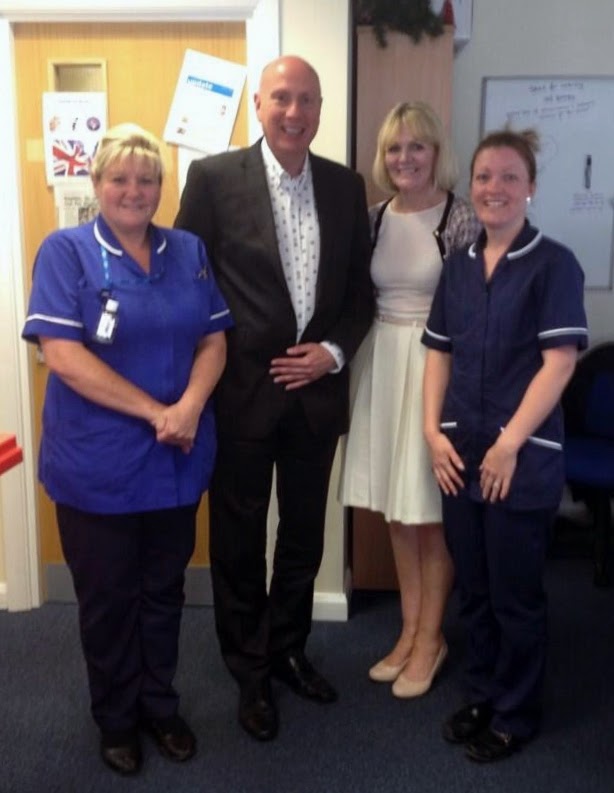
"It is a testament to their unwavering commitment to providing the best possible care to patients" - visit to Bury walk in centre

I recently visited the team at Bury walk in centre.  They’ve had a difficult time of late due to mounting staffing pressures, which has meant the centres at Bury and Prestwich have been having to close on some days.  

There has been some uncertainty around the future of the centres following a review of urgent care across Bury but Bury Clinical Commissioning Group has recently announced that the centres at Prestwich and Bury will remain operational until at least 31 March 2018, whilst further plans are formulated.  The CCG has been working with Pennine Care and GP provider BARDOC to develop proposals to stabilise service delivery at both centres until this date.  As a result, Prestwich is now being managed by BARDOC and Bury will continue to be managed by Pennine Care.  This is a welcome move, as it means our staff will be able to continue to safely provide a consistent service to local patients. 
 
Just to confirm the opening hours are as follows:
  • Bury walk in centre: 7am to 3pm*, seven days a week - First floor Moorgate Primary Care Centre, 22 Derby Way, Bury, BL9 0NJ
  • Prestwich walk in centre, 12pm to 8pm*, seven days a week - Fairfax Road, Prestwich M25 1BT
* The last appointment is 30 minutes prior to closing to enable staff to appropriately and effectively assess people.
 
We will continue to support the team whilst the urgent care review is ongoing.  I recently met with the Bury North MP James Frith to talk about the walk in centres and what efforts the trust is taking to ensure they remain open.  It was a positive discussion and one I am sure will be revisited once future plans are confirmed.
 
Despite the challenges facing them, the clinical and management team have shown great resilience and determination.  They shared many examples of where staff have gone over and above to make sure the centres could open.  It is a testament to their unwavering commitment to providing the best possible care to patients.  

Thank you,
Martin

Martin Roe
Chief Executive (Acting)


Wednesday, 9 July 2014

An eye opening visit to Bury

There are many good reasons to go to Bury - the World Famous Bury Market  or the East Lancashire Steam Railway or the very beautiful Burrs Country Park... but last week I went to Bury for a very good reason, to visit the Bury Community Stroke Team. 

I mention Bury’s well-known tourist attractions such as the World Famous Market because people travel far and wide to visit. Yet when we mention examples of healthcare worth travelling to see, Sweden or USA are often mentioned, but not Bury.


Well, I spent an inspirational afternoon with the Bury Community Stroke Team, managed by Lisa and led by Jo, and it was well worth the short journey up the M66.  As much as I’d welcome a visit to Jönköping or Boston, the Bury Community Stroke Team show we can reach for world class care here in the UK!

The service is a great example of where commissioners and providers have come together to do the right thing for patients - improve care pathways and empower people to manage their own healthcare needs.

Whenever I read about healthcare, plan strategy or visit services, I look for a number of things - a well-led service, clear operational plans and specifications, the promotion of self-care, whole person care and the holy grail of good physical and mental health care combined. 

If I had been playing community stroke service Bingo (that well known pastime!) I would have been shouting ‘house’ after thirty minutes of Jo and her team describing their service: 
  • Did they measure outcomes that could be part of an overall indicator of performance to demonstrate value? Tick - they use EQ5D5L, something I hadn’t known about but understand other community services uses also.  Excellent.
  • Do they promote self-care? Tick - they are running a self-care course and are also developing modules to be run through the Trust's Living Well Academy
  • Technology? Tick – they use Healthtalkonline and Speech and Language Therapists use apps to help people following a stroke.
  • What about the psychological aspects of the community care pathway for stroke? Tick - The team has worked with the Bury psychological therapies team to develop the psychological offer in the overall care pathway. They are now trained in Brief Solution Focused Therapy and Motivational Interviewing and speak positively about whole person care. 

As I said I was inspired and it was a perfect example of how Trusts like Pennine Care are well placed to provide whole person care to our patients. 

I can’t do justice to how impressive this team really is. It’s early days and they are still building the data to measure overall performance, but all the core ingredients are there to deliver a world class service. The team should be rightly proud of themselves and commissioners congratulated for attending to the out of hospital care needs on the stroke pathway.

District nursing visit 

A few days later and I was back in Bury.  I know there are great quality bargains to be grabbed on the market but I didn’t have time to stop unfortunately, as I was visiting one of the district nursing teams for work. Although I’m not sure having the privilege to spend time with dedicated, skilled, professional nurses can really be described as work. 


I spent the morning with Sian, Vicky, Karen and Jo talking about the challenges faced in district nursing services.  I was fortunate to shadow Karen carrying out her clinical duties and talking to her reminded me how complex and demanding the district nursing role is.

In my last blog, I talked about polarities and managing change and within Pennine Care we have recently carried out a district nursing review, involving nurses from all of our boroughs. 

We and system leaders up and down England mustn’t forget that district nurses are busy, skilled professionals who carry out complex, difficult and demanding work. 

As hospitals try to move care outside of hospital and GPs look for support to high levels of demands, where does the care go?  Into community services and often to the district nurse. They can rarely say no to demands, go about their hard work effectively (but often quietly) and make a huge difference to the lives of people who need their care.

The community models of care, especially district nursing, need dedicated thought leadership, investment of time and resources to develop models and an understanding that a district nursing team has the same floors and ceilings of capacity as a ward does. 

We talk about hard truths for ward staffing levelswhich I fully agree with, but it isn’t just wards that have to be safely and effectively staffed, so does the community.

It was a real pleasure to spend time with such a hard working team, not short on ideas on what they feel needs to be done. But I think the NHS system needs to listen more to their voice and not overlook the community filling in the sandwich between primary care and hospitals.